Loading...
6/28/2026
The Notice
Helping you see clearly what is being built next door before it is too late.


Built At
HuddleHive's WIT Hackathon #6
Hosted By
The Notice: Helping you see clearly what is being built next door before it is too late.
Framing the Problem
UK planning data is legally public, but it is practically invisible. This is the exact problem Wise tackled with international currency exchange, applied to local government.
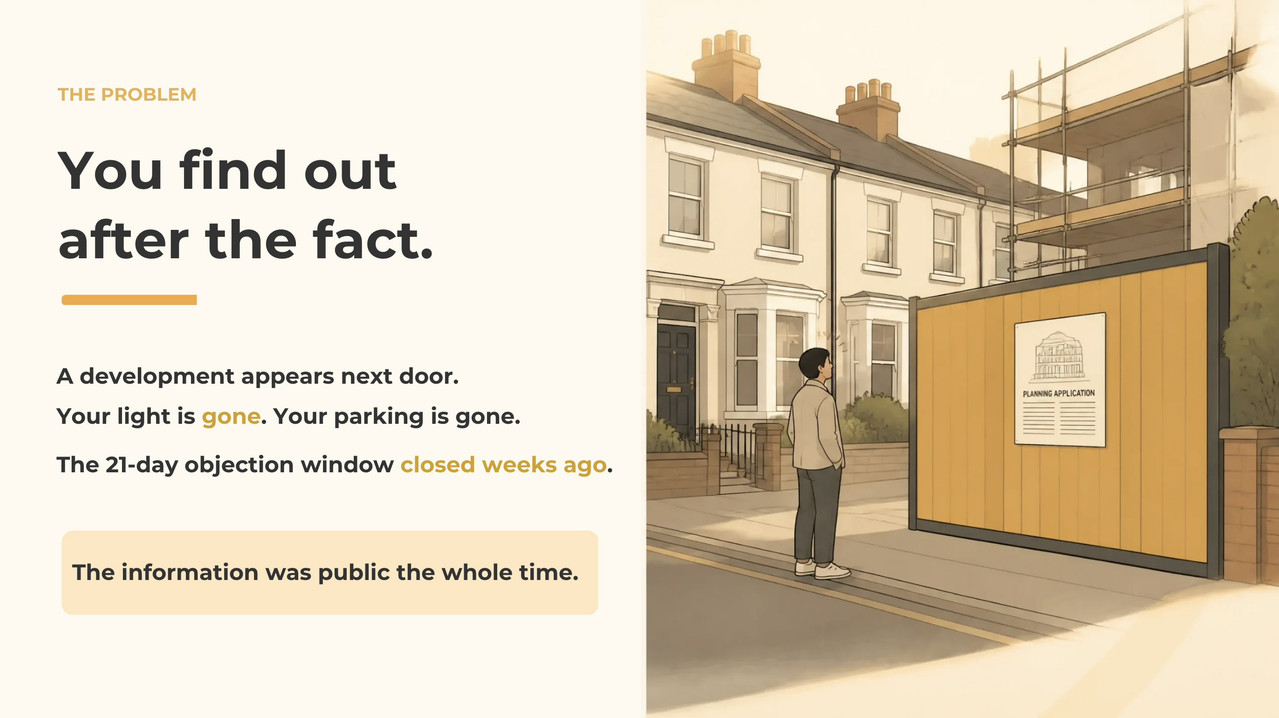
When a traditional bank advertises a "free" international transfer, they hide a massive fee inside an inflated exchange rate. You only realise you have been overcharged if you know exactly where to look. The UK planning system uses the exact same tactic of deceptive openness. When a massive building project or housing development is proposed right next door to you, the legally required "public notice" is a piece of paper physically stapled to a lamp-post on your street.
If you miss that paper sign, you are forced to navigate dozens of separate, confusing council portals. Each one is written in dense legal jargon, intentionally obscuring the details of what is actually being built. To make matters worse, residents are hit with a strict, ticking 21-day countdown to submit an objection.
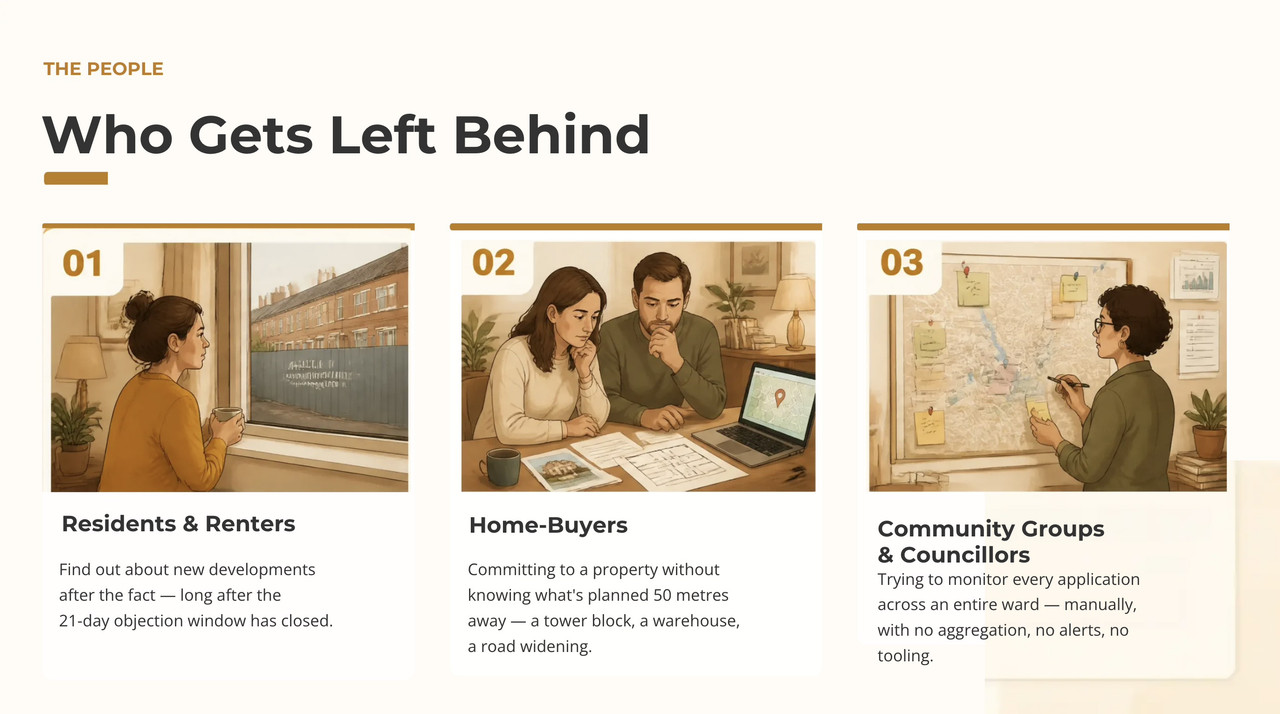
Because the data is so buried, the vast majority of residents only discover a disruptive project after the concrete mixers arrive on their street and the deadline has long closed. This is a massive open-data failure. The government can claim the information is "technically public," but in reality, it is completely inaccessible to everyday working people, renters, and local community groups. Civic participation is effectively blocked, leaving the entire system skewed in favour of deep-pocketed developers who have the specialized time and resources to dig through the noise.
Idea and how it works:
Notice is the digital lamp-post notice that actually reaches you. We take this buried data and bring it straight to your screen in plain English.
Here is how the product works:
Enter a Postcode: Instantly see a live map and list of every active planning application around you, sorted by distance or urgency.
Plain-English AI Summaries: Click any project to get a clear breakdown generated by AI. It explains exactly what is being built, how it might impact you (noise, parking, light), and valid grounds for objection.
Objection Countdown: A clear visual timer shows exactly how many days you have left to have your say before the window closes permanently.
Who Is Behind It: We cross-reference the application with Companies House data so you can see the developer's corporate history and other local projects.
Draft an Objection: One click generates a solid starting draft for your letter, grounded strictly in valid planning rules.
Smart Alerts: Enter your email to follow an area and get updates when a new project pops up nearby.
Implementation
The Stack: Built using Next.js, React, and TailwindCSS, with Leaflet providing the interactive maps.
The Connected APIs: Our backend securely talks to postcodes.io for locations, the PlanIt API for council data, and Companies House for corporate backgrounds.
The AI Layer: We use GenAI to instantly read heavy legal documents and format them into friendly bullet points, with strict settings so it never invents facts.
Monetisation Strategy
The platform will always be free and accessible for local residents to check their own streets. To ensure the project is self-sustaining, we will use a freemium subscription model that charges for high-volume use and advanced features:
Free Tier (For Citizens): Unlimited postcode browsing, live map tracking, core AI summaries, and one free active email alert (perfect for monitoring your own home).
Premium Tier (For Multi-Property Owners): A paid monthly subscription for users who need to create multiple location alerts, such as landlords, neighbourhood community leads, or home-buyers tracking several areas.
Pro Tier (For Property Professionals): A premium subscription unlocking advanced features, including unlimited watch zones, deeper AI analytical tools, and automated portfolio management helpers.
Challenges & What We Learned
Our biggest takeaways came from how we worked together as a duo:
Pivoting Fast: We initially spent a lot of time on a completely different idea. When we realised it would not work, we had to throw it out and start fresh. It was frustrating, but we learned how to bounce back quickly, drop our egos, and align on a new direction.
Team Dynamics (Big Team vs. Duo): Having done hackathons in teams of five, working as a pair this time showed us the balance of both worlds. Large teams are amazing for vibrant brainstorming, diverse ideas, and a high-energy social atmosphere, but they require a lot of alignment. As a duo, we had less manpower for brainstorming, but our execution was lightning fast. Communication was instant, we agreed effortlessly, and we could pivot in seconds without endless discussions. Both setups are great; we just learned how to lean into the unique speed of a smaller partnership.
Next Steps
Live Triggers: Build a nightly automated scraper that checks for updates and immediately emails users when a local deadline changes or a new project is submitted.
Visual Timelines: Add interactive charts and progress bars to show exactly where a project stands in the council approval process.
Monetisation: Keep the app 100% free for local residents, but introduce a paid premium dashboard for real estate agents and developers who need to track multiple areas, analyse historical trends, and use advanced portfolio tools.